Biography
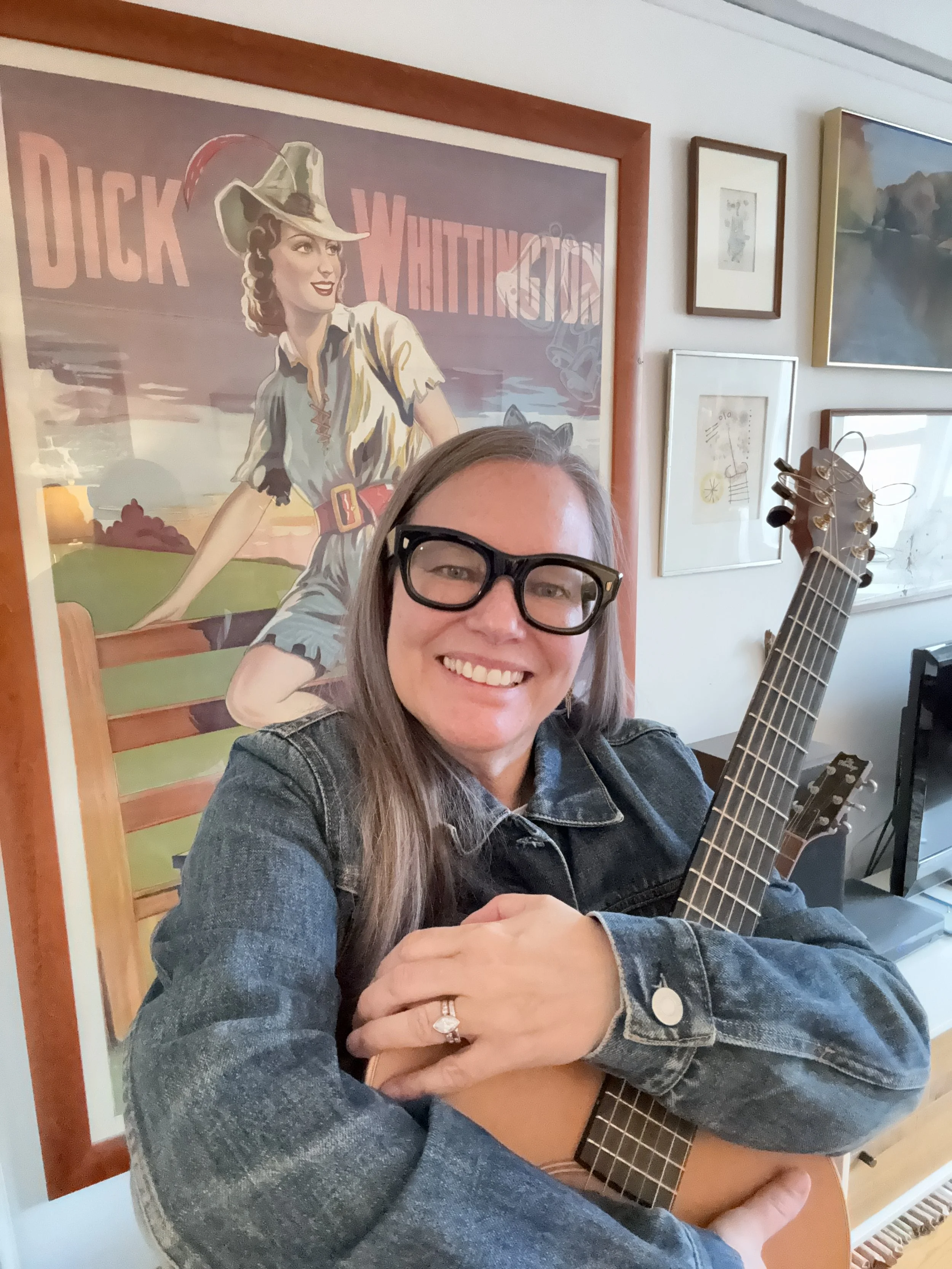
Jennie Arnau’s face lights up when talking about her new album, her first since 2009’s Chasing Giants. Her comeback record, A Rising Tide, fuses world-weary understanding with an overwhelming tenderness that pierces the heart. She takes her time across 1413 songs to tell her story – one of great resilience and determination. Her voice ricochets like a pebble on a pond as she processes frustrationanger and impenetrable sadness over her mother’s death.
Her star had only just begun to shine when her mother was diagnosed with dementia. Heartbroken, she felt it was time to step away. What started as a brief hiatus turned into a decade-long absence, during which her songwriting held great healing powers. She had no intentions of stepping into a studio, but through encouragement from friends, she dared to take that leap.
“They thought it would be a good idea to reconnect with my love of playing and the joy it has always brought me,” she reflects. “I decided they might be right, but this time, I realized I wanted to hear the songs that mean so much to me, that carry so many memories and love. I wanted to share the experience with the musicians I have called my chosen familyfriends for so long and who have supported me through the highs and lows of the last 15 to 20 years.”
She adds, “I cherish these songs. I didn’t know if I wanted to release them or not, and I honestly didn’t care. I just really wanted to play the music with my friends.”
With A Rising Tide, she brings together some of thoseher most talented friends to share the spotlight. If she was going to do this, she was going to do it right. Across the record, you’ll find such talented players as Pete Levin (The Highwomen, Mavis StaplesGregg Allman) on keyboards, Jacob Jolliff (Yonder Mountain String Band, Bela Fleck) on mandolin, Alan Lerner (The Joni Mitchell Project, The Zen Tricksters) on drums, Mike Savino (Tall Tall Trees) on banjo, Skip Ward (Steve Martin, Tony Trischka) on bass (Steve Martin, Tony Trischka), Dap King Binky Griptite (Amy Winehouse, Sharon Jones) on guitars, and Greg McMullen (Chris and Trixie Whitley) on pedal steel and guitar.
Producer and engineer Phil Palazzolo, whose credits include Neko Case and Jessel Malin, focused Arnau’s talents and pushed her to dig deep into her soul. Throughout the album’s 1413 songs, you’ll witness an artist radiating healing from the inside out. Her pain doesn’t define her, but it does inform where her muse took the music. “One if by Land” documents the fear when she realized her mother, as she knew her, was slipping away. It was during a phone call that reality set into her bones–that this woman would never be the same. “It scared me so much because that’s the moment I knewrealized she was going–that was that. There was no turning back,” Arnau says. “She was losing her ability to communicate, and so I wrote this song about trying to reach across the ever-growing distance and hoping and praying I could save her.”
Arnau needles an emotional transcendence throughout the album’s rich musical fabric. “Oceans Rise” sets the stage as she plucks the delicate and dying petals of a relationship, relinquishing the pain as though exorcised from her body. Her vast arsenal of songwriting tools serves her well, as she carves out raw human stories. With “Mabel,” she observes how “everyone loves Mabel,” she sings. “There’s something in her smile / when she enters a room / It’s like sugar in chocolate / Strawberries in June.”
That plucky spirit is also present in “Back to Carolina,” an ode to the many meanings of home. “Going back to Carolina / I’ve been gone too long / Tried my best to love this place,” she sings. “But it just ain’t my home / Breaks my heart to leave you / Lord knows I don’t wanna say goodbye.” She then sets her sights on the open highway with “Countryman,” a toe-tapping travelin’ tune, and reflects upon today’s uncertain times in “Better Luck Next Time” with heavy introspection.
There’s an intimacy embedded in the lyrics. The musical spaces allow her to play, to find that deeper context that speaks truthfully to human existence – both her own and those of the listener. She might write with an eye for personal anecdotes, but between the cracks, there’s a universality that drives her forward.
The album’s crown jewel is the magnificently subdued and brittle “Young & Alone,” a downcast ballad about school shootings. “It felt ugly and messy,” she says. Arau cobbles together sad and broken pieces into an intense mosaic of what it means to be young and very much alive, with the sorrowful realization that it could all be yanked away in an instant. “The news on the TV is so devastating, I think I might vomit,” she sings. “The newscaster’s fainting / How can we live in a world so broken?”
Her words are undeniably piercing. “Young & Alone” is a call to action, a response to the alarming coldness and lack of compassion coming from sectors of the government. “I’m not really wounded, but I’m bleeding out badly,” she continues over stark piano and little else. “Evidence of the violence left under the table / I don’t think I’m able to smile that way again.”
The stunning mastery found on the album, from the mellow guitar work on “Sail Away” to the jaunty melodic line of the closing track “Sunshine,” proves she’s an artist who has never lost her spark. “We’re kind of all going through the same thing in different ways, and I just wanted to get my own feelings out there,” she offers about the album. “Even though sometimes, it may not feel like it, we all go through the same feelings and emotions.”
That emotional journey connects us all. There’s a resonant quality that echoes in her music, as she pulls from her many lived-in experiences. A member of the LGBTQ+ community, she uses songwriting to offer compassion and understanding, unifying qualities during these trying times. "Every cross is my cross to bear,” she offers. Her activism began decades ago and focused primarily on the LGBTQ+ community. But as things shifted in recent years, she opened herself up to fight for everyone’s rights. In showing unity, we’re much more powerful than we are on our own. "Let's just march all the time. Let's let them know. Let's constantly try to throw our voices out there to say, ‘This is not what we want,’” she adds.
The impact of her words is immense. Jennie Arnau unflinchingly stands her ground, uncompromising in what she believes and how she writes music. A Rising Tide arrives as an insightful, bold, and musically satisfying collection. Sitting somewhere in the realm of Waxahatchee meets Jason Isbell meets Sheryl Crow, the album is best served with long car rides down south, up the East Coast, or out into the countrysidelong car drives down the East Coast or out into the countryside, where nature’s beauty is both striking and earnest.
When it comes to releasing such personal material into the world, she’s hopeful that the listener will be taken on a journey and able to rediscover what it means to be alive. We’re not alone, after all, and therein lies the most important message. "I hope the listeners hear something that they can relate to because it means a lot to me” she concludes. “I just hope that somebody finds a little bit of solace, and they understand that none of us are in it alone."